Advanced Practice
Same rule as always: Get your hands dirty! The three advanced chapters gave you the route; this chapter gives you two things: a systematic set of open courses (to fill in your theory training), and a hands-on checklist (to build a feel for it).
Systematic open courses
It's worth setting aside a few months for the University of Pennsylvania's Robotics specialization on Coursera. This specialization doesn't have much to do with robot arms or industrial robots, but since many aspects of robotics are shared, I highly recommend it, and several of its courses line up neatly with this part's main threads:
- Perception: a very high-quality course, essentially covering camera models, multi-view geometry, and the like. This material is a big help for future research in SLAM, 3D vision, calibration, and so on; it maps to "3D Vision." After finishing it, you'll be able to produce effects like the one in the article A demo of how AR works (in Chinese):

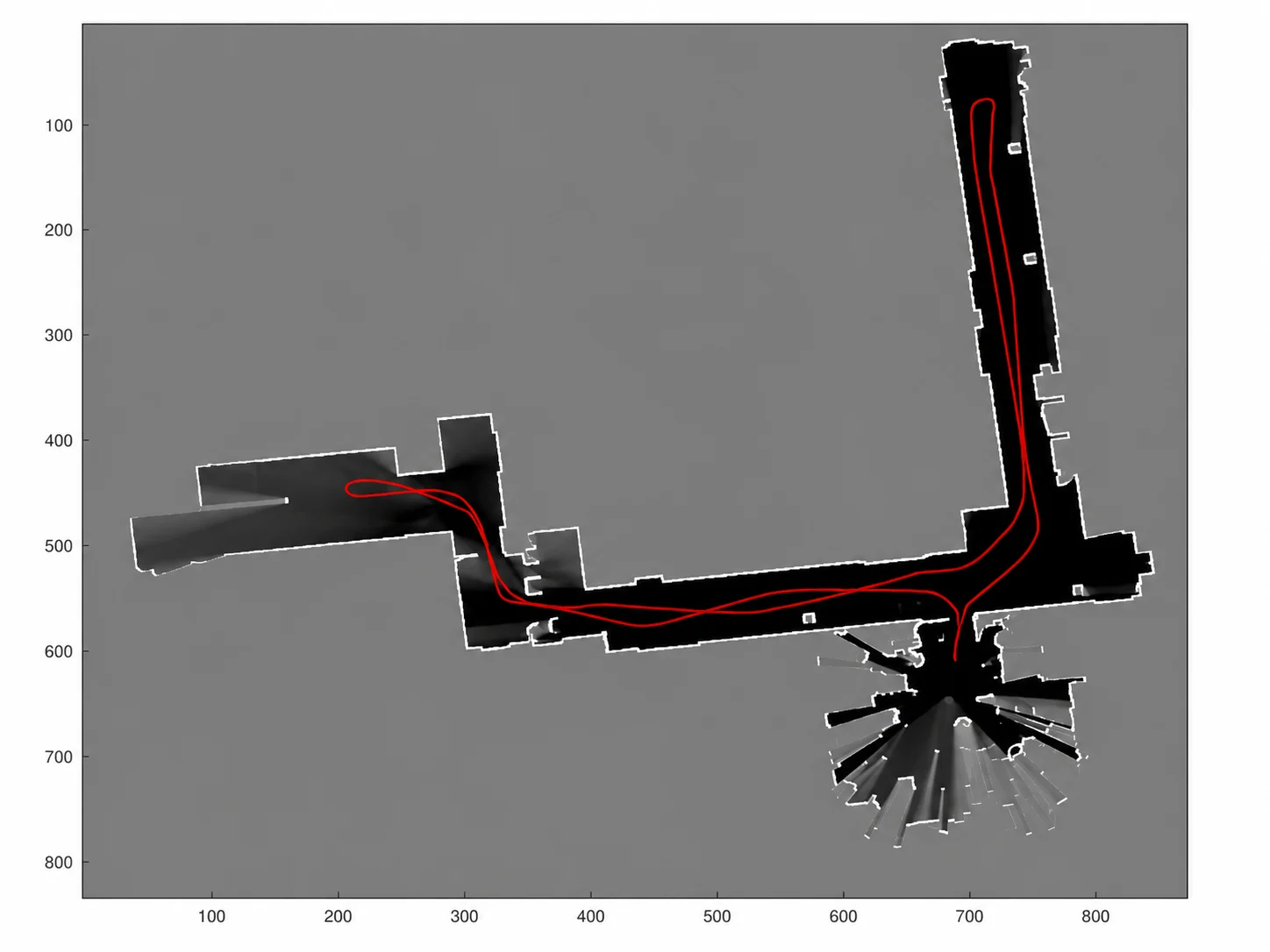
- Estimation and Learning: starting from the Gaussian distribution, this course introduces tools that are very useful in robot state estimation, like the Kalman filter and particle filter. And its major assignment has you write a 2D map-reconstruction program from scratch, so you'll learn how to use laser-sensor data to build a 2D map like the one below.
-
Aerial Robotics: mainly about the control of quadrotor drones; its trajectory planning, orientation description, and control are all very helpful for studying arms. The assignments are also very high-quality, providing a Matlab-based numerical simulation module that lets beginners see the control effect of their own code directly;
-
Computational Motion Planning: this one feels a notch below Aerial Robotics in quality, but it gives you a rough sense that there's a Motion Planning direction in robotics, and its major assignment includes hand-writing basic motion-planning algorithms like A*, PRM, and Potential Fields, along with a rough idea of the basics of collision checking; it maps to "Autonomous Planning";
-
Mobility: mainly about the control of legged robots. On one hand, it gives you a rough sense of how legged-robot control developed, so you won't be quite so lost watching Boston Dynamics videos. More importantly, it teaches you the relationship between robot modeling and control: a simplified model can still be a huge help for control, which incidentally lays the groundwork for the reinforcement-learning motion control in the Embodied AI part.
Beyond this specialization, two more good resources: for the visual control of arms, see Robotics: Vision and Control 3rd (Peter Corke), which has Python and Matlab editions and also covers some of the Perception material; and for anything related to Aerial Robotics, see Prof. Quan Quan of Beihang University's drone course series (in Chinese), which comes with a simulator.
The hands-on checklist
The first two items are pure software: one computer and you can start. The accompanying runnable code will be released alongside the open-source libraries, but there's no need to wait: every item on this list can be done independently right now with off-the-shelf open-source tools (NumPy/SciPy, OpenCV, PCL, MoveIt).
-
Orientation-interpolation experiment (maps to Modern Robotics, Application 1): implement Slerp and the Lie-group Bezier blend, have a rigid body pass through three orientations in turn, and plot how the angular-velocity direction changes over time. You'll see with your own eyes that "straight-line interpolation jumps at the transition point, while the Bezier blend is continuous."
-
Average-rotation experiment (maps to the boxed example in Modern Robotics): randomly generate a set of rotations, compute the average rotation with all four methods (Euler-angle average, quaternion average, tangent-space average, and numerical optimization), and compare the results; while you're at it, get fluent with the matrix exponential and logarithm.
-
Camera calibration + hand-eye calibration (maps to 3D Vision): use OpenCV to run a complete calibration pipeline: 20 photos of a calibration board for the intrinsics, then
calibrateHandEyeto solve AX=XB. Without a real machine, you can run the whole flow in simulation just the same. -
Point-cloud filtering (maps to the "pitfall" in 3D Vision): take the point cloud from any depth camera (or a public dataset), run voxel downsampling + radius filtering with PCL, and watch the outliers get cleaned out.
-
MoveIt planning (maps to Autonomous Planning): URDF → Setup Assistant → get motion planning running in simulation. Once it works, do two little experiments: plan the same problem ten times in a row to feel the sampling planner's "different every time"; then add a virtual view cone to the scene as an obstacle, reproducing the "don't block the camera" constrained-planning case.
Keeping up with the frontier
By now, you can already read most of the latest papers. So you should follow conferences like RSS, ICRA, and IROS to keep up with the latest progress in robotics, and learn the latest theory through journals like IJRR and TRO.
You can also subscribe to the relevant keywords through Google Scholar, and it will push the latest papers to your inbox from time to time.