Preface
After interviewing quite a few people who work in robotics research, I keep coming back to one observation: most of them, however strong in their own specialty, have never been formally trained in robotics as a whole.
On paper, they look the part. Most majored in mechatronics, electrical engineering, or computer science; some came straight out of labs that build robots; many have worked at robotics companies. By any résumé, these are professionals.
But interview after interview, few of them have a complete picture of the field. Someone who lays out circuit boards may never have analyzed a robot's workspace. Someone who designs mechanisms may never have used dynamics in control. Someone who writes control algorithms may not have met configuration space. Someone in motion planning may not have run into Q-learning. Someone in deep reinforcement learning may not know how to turn the policy they've learned into actual motion on a real robot.
Looking back on my own years as a student, I understand why. When I started my PhD, I inherited the SmartPal robot from a senior labmate. Leaning on his "hand-me-down code," I even managed to bluff my way through a few demos for visiting guests:
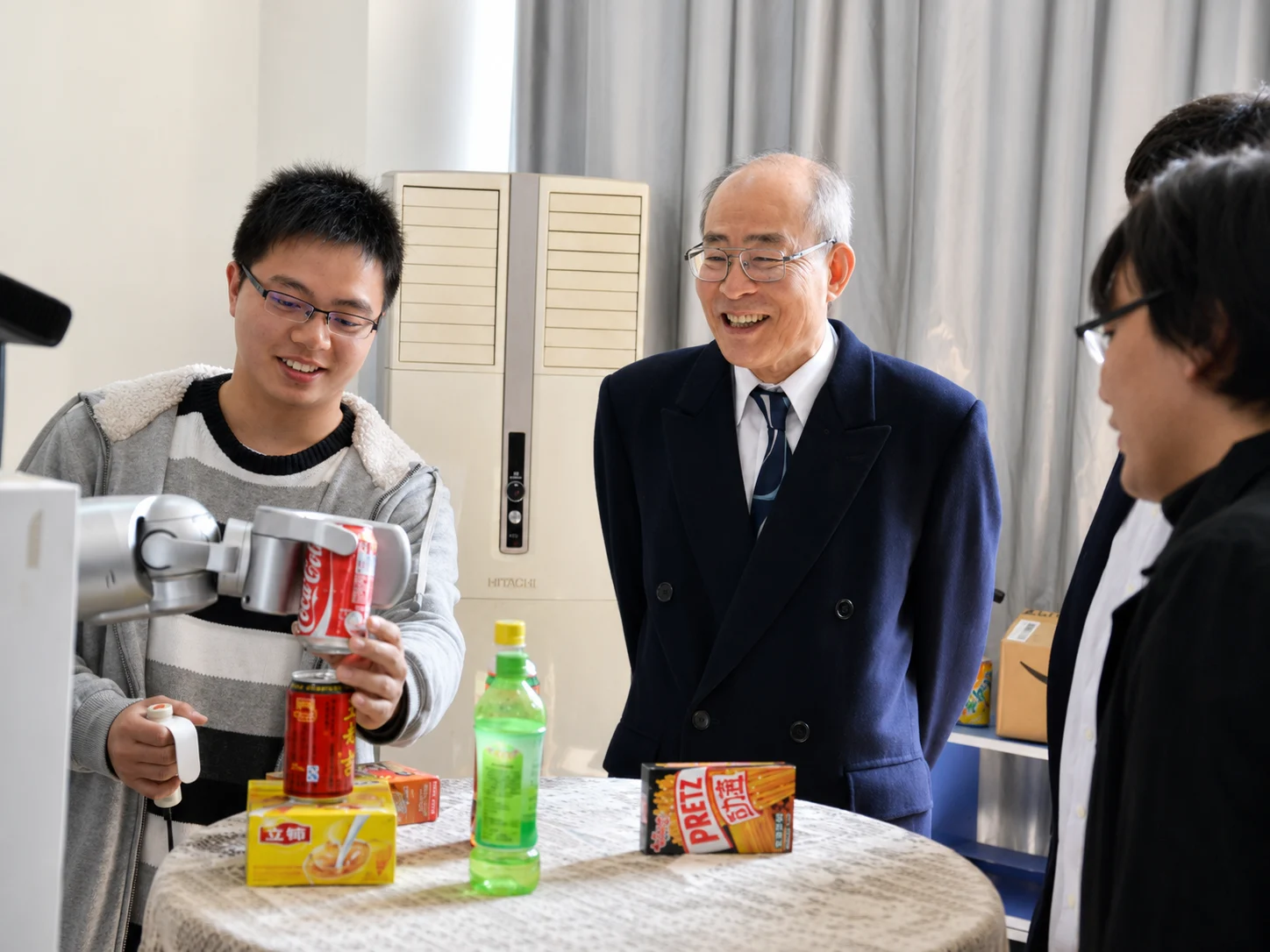
But when I finally sat down and read that hand-me-down code, I found that all it ever sent to the robot was a handful of joint position points.
"Where is the PID???"
That was my biggest question at the time. The logic of this code was nothing like the quadrotors and smart cars I'd tinkered with as an undergrad.
So, question in hand, I asked around the lab. No answer. Later I took several robotics-related graduate courses, and a year of coursework later I still didn't have my answer.
Here is the part that stuck with me. This was one of the earliest institutions in China to take up robotics research, yet its graduate robotics courses covered little more than how to set up DH coordinate frames; for dynamics, we worked through a single planar three-link arm. Control and trajectory planning never came up, and we weren't even asked to solve the inverse kinematics.
As far as I could tell, several other institutions were similar. At least among the people I've met, robotics training in mainland China often isn't organized as one coherent curriculum; many graduates picked up whatever a given project happened to need, largely by teaching themselves. That path can produce genuinely capable engineers who have nonetheless never once worked through a robot's inverse kinematics.
Not that inverse kinematics or trajectory interpolation are especially hard. The point is narrower: if you only attend classes, it's easy to finish a program in mainland China without ever being asked to master, or even encounter, these fairly basic parts of robotics.
The graduates I've met from programs abroad, or in Hong Kong and Taiwan, less often had this gap; the courses they described tended to cover the main topics and to require real coding. I wouldn't want to read too much into one person's set of interviews, but the pattern was consistent enough to be worth naming.
So yes, many of us come to robotics without that structured foundation. In my experience, though, the students I've worked with are very capable: with a bit of the right guidance, they pick this material up quickly on their own. So let's look at how someone without a formal robotics background can go about learning it.