Prerequisites
Of course, what counts as a "prerequisite" keeps shifting as your research goes deeper, mathematics most of all. Math is a bit like the Sharingan: stare at the same stone tablet, and a different "level" of Sharingan reads something completely different off it.
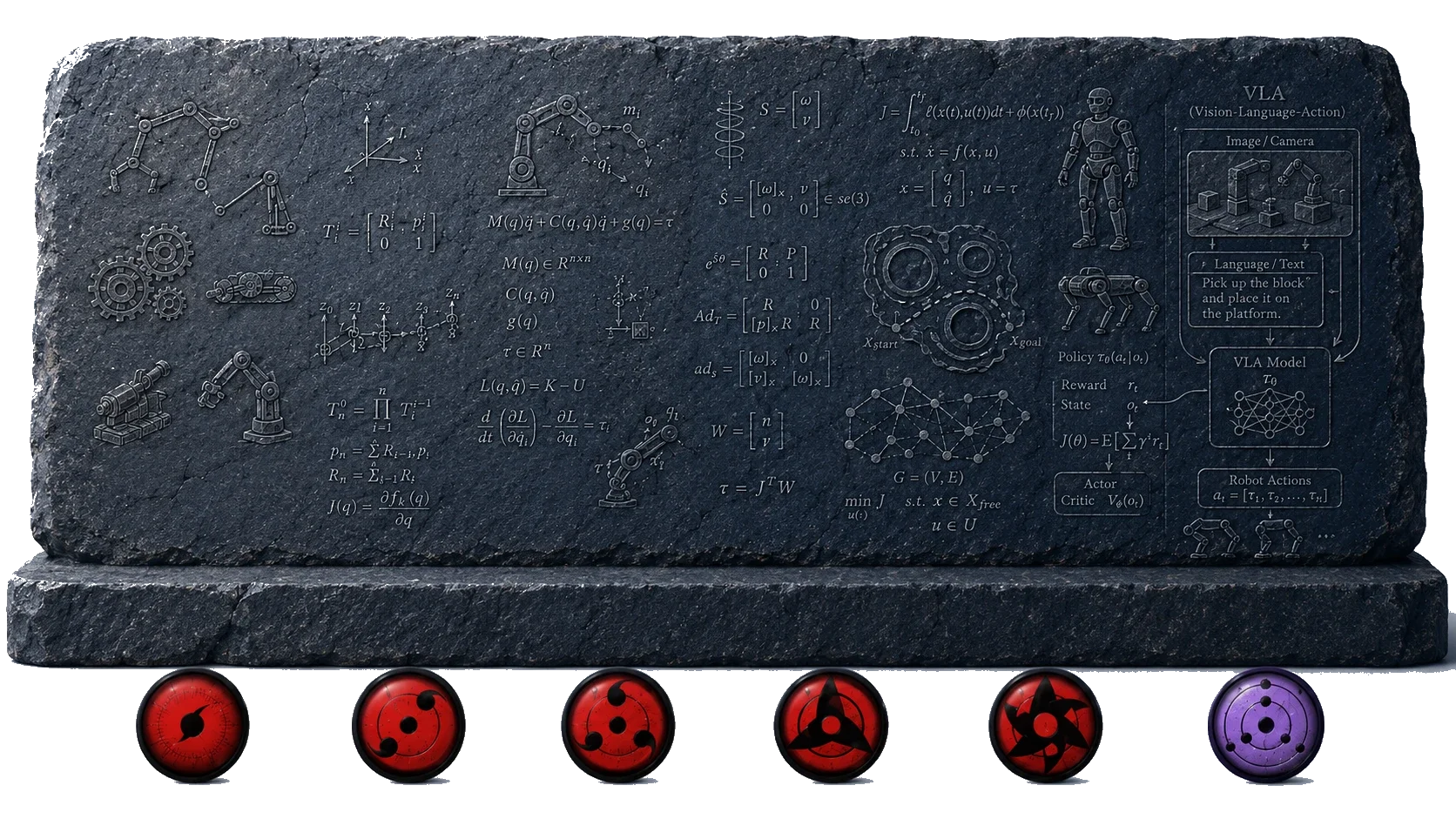
If all you have is arithmetic, you can still train up as a robot commissioning engineer. Add linear algebra and calculus, and you can handle the basics of kinematics and dynamics modeling. Add numerical methods, convex optimization, and differential geometry, and you can start taking part in work on identification, planning, and learning.
But robotics is a wide field, and different directions call for quite different foundations. Sinking into a "prerequisites" swamp right at the start can cost you more than it's worth.
So here's what I'd suggest: nail down a few of the most basic prerequisites first, and pick up the rest as the relevant chapters bring them up.
-
Comfort reading technical English. Much of the clearest, most approachable material in robotics (textbooks, papers, documentation) is written in English, so it helps to be at ease reading equations, technical prose, and reference docs in it. (If you're reading this English edition, you've cleared this one already.)
-
Linear algebra. Every spatial transformation, and really almost every robotics computation, rests on linear algebra, and it helps to build some basic "vector space" intuition. My top pick here is Prof. Gilbert Strang's Linear Algebra; the lectures are on YouTube, and also on NetEase Open Courses with Chinese subtitles. From the very first lecture he gets you looking at problems spatially, rather than drilling on how to compute determinants.
-
Calculus. Anywhere robotics touches derivatives, integrals, or optimization, you'll need calculus, so it's another one you can't get around early on. I don't have a great video to recommend; maybe take a look at Gilbert Strang's Highlights of Calculus (also on NetEase Open Courses, in Chinese)?
-
Theoretical mechanics. Robotics is a daily wrestling match with forces. But most robotics textbooks won't carefully derive spatial transforms, the principle of virtual work, or the Lagrangian formulation, and this material is fairly abstract, so many self-learners stall out right here, in the dynamics chapter. I don't have a great resource for this one either. On XuetangX there's Prof. Gao Yunfeng's Theoretical Mechanics (Tsinghua, in Chinese), worth a look. (Though back when I sat in his class, I could never quite stay awake.)
-
Matlab or Python. Both are easy to pick up and great for visualizing data. As you learn robotics, a scripting language like these lets you knock out a quick implementation of an algorithm and check your own derivations against it. You only need the basics here: matrix operations and plotting; the fancier usage can wait. Intro courses for both are easy to find on Coursera: Matlab, Python.
-
Control theory. Robotics is inseparable from control, even though robotics textbooks tend not to say much about it. It's true that most industrial robots today still run fairly simple algorithms, but as a researcher you'll want some basic control theory: PID, state-space models, observability, controllability, Lyapunov, optimal control, a bit of nonlinear control, and a bit of intelligent control. For this, take a look at Brian Douglas's videos on YouTube; there's also a Chinese-subtitled version on Bilibili (in Chinese).
-
Digital and analog electronics. Robotics is a hands-on science: you've only really mastered something once you've turned your derived formulas into code and gotten a real robot to move the way you intended. Some digital and analog electronics gives you a basic grasp of logic circuits, enough that you won't be left wondering why a motor needs a driver in front of it. It also makes it easy to throw together a small circuit for control experiments when there's no actual robot on hand. Any decent textbook will do; the one I used back then was by Prof. Tang Qingyu.
-
A little microcontroller work. Digital and analog electronics alone won't get you a working control circuit; you also need to turn that knowledge into a real circuit that runs your control code, and that means microcontrollers. Buy one of the cheap minimal-system boards online that come with servo-motor tutorials, and learn a bit of Arduino or STM32. Better still, if you can get into something like RoboMaster or the NXP Cup smart-car competition (formerly Freescale), you'll come away with a basic feel for all the embedded modules.
-
Linux and C. Now that we have the circuit side, we need to turn our formula-code into instructions the circuit can run, which brings in embedded programming. I'd learn a bit of C here. Embedded work doesn't ask much of your C; a little syntax is enough, for example Getting Started with C (in Chinese). But if you think you might do more high-level work down the road, better to learn C properly from the start. For programming, Linux is a good environment to be in, so this is a fine moment to install a Linux system and learn C on it.
-
Basic 3D design. When you're building an experimental platform, you'll often need to design and machine small parts, and knowing a 3D design tool can dramatically speed up development; SolidWorks is a good choice. Pair it with something like a 3D printer and you can do rapid prototyping. (And even without a printer, online 3D-printing services are easy to find; just send them your design files.)
-
Bilibili (mainly for Chinese-speaking readers). Bilibili (bilibili.com) hosts a surprising wealth of learning material: many foreign and Coursera courses appear there as free, subtitled videos, alongside recordings made by people a few steps ahead of you. English speakers will usually find the original versions on the platforms mentioned above (YouTube, Coursera, MIT OpenCourseWare). (in Chinese)
-
AI tools. Today's frontier large language models already outstrip most people on many specialized topics, so lean on them as you learn: have them help you understand concepts, write verification code, track down authoritative references, and talk through the points you're stuck on. It's a real force multiplier. When you get the chance, use the best model you can.
Roughly speaking, all of this is about where a third-year undergraduate in a field like mechatronics, electrical engineering, or automation should be. Once you have a basic handle on these pieces, you're ready to start in on robotics itself.